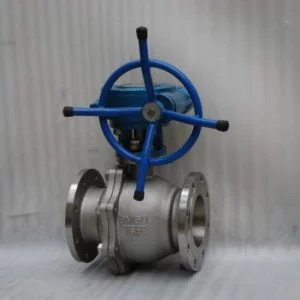
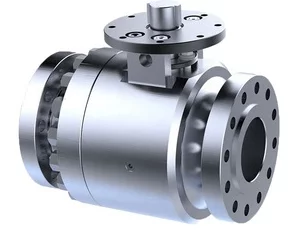
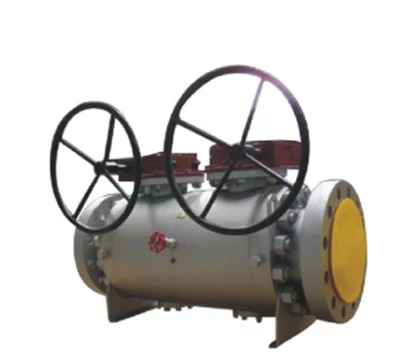
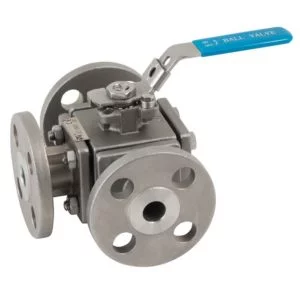
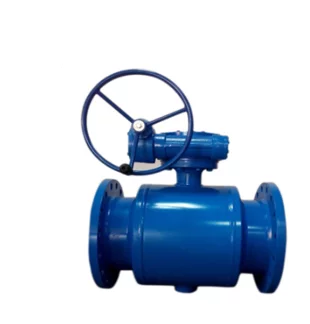
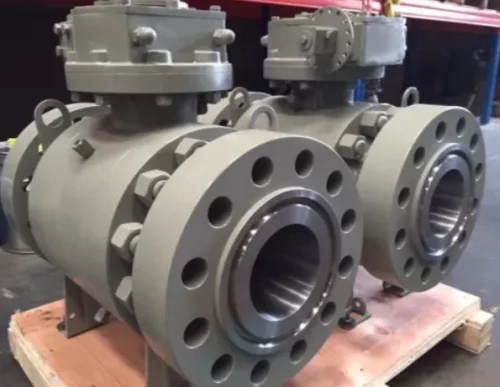
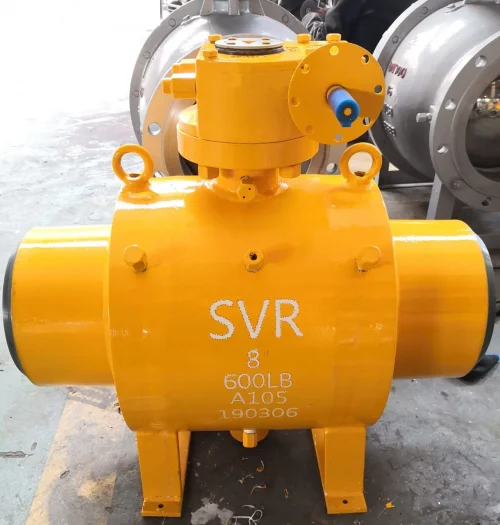
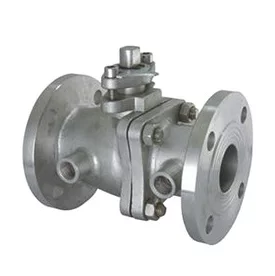
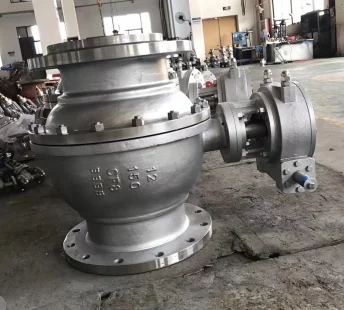
Floating ball valves are widely used in industrial piping systems to isolate the flow of liquids and gases. Their simple quarter-turn operation makes opening and closing quick, while the straight flow passage helps reduce resistance when the valve is fully open. The ball is supported by the valve seats and can move slightly under pressure to maintain sealing contact.
Valves Only Europe is a Floating Ball Valve Manufacturer in Germany, providing cast floating ball valves in carbon steel, stainless steel and alloy steel. The range covers full-bore and reduced-bore configurations, with manual, electric and pneumatic operation. These valves are used in oil and gas pipelines, water treatment facilities, chemical plants and other industrial process systems.
| Operation |
Function |
Design |
| Quarter-turn |
Flow isolation |
Floating ball |
Design & Working Principle
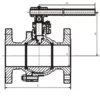
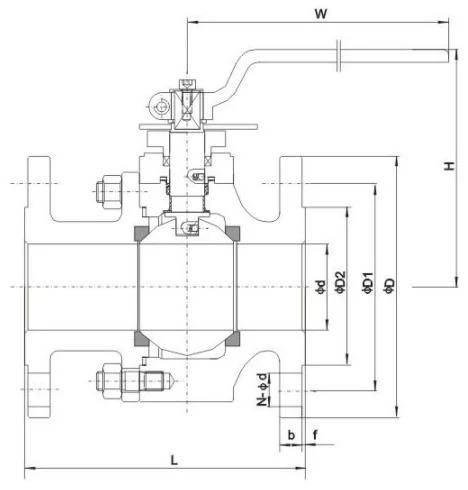
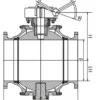
A floating ball valve uses a spherical ball with a hole through its centre to control fluid flow. When the hole lines up with the pipeline, fluid passes through the valve. Turning the handle or actuator through 90 degrees moves the solid part of the ball across the flow passage and stops the flow. The valve can be supplied in full-bore or reduced-bore designs, depending on the required flow capacity and piping arrangement.
The main difference between floating and trunnion-mounted ball valves is how the ball is supported. In a floating design, the ball is held between the seats rather than fixed at both ends. When the valve closes, differential pressure pushes the ball slightly towards the downstream seat, helping form the seal. Floating ball valves are generally selected for on-off operation, as they are not intended for continuous throttling.
Key Product Features
| ✔ Full-bore and reduced-bore designs |
✔ Quarter-turn operation for quick shut-off |
| ✔ Low flow resistance when fully open |
✔ Pressure-assisted downstream seat sealing |
| ✔ Anti-static design |
✔ Bidirectional flow isolation in suitable designs |
| ✔ Manual, electric and pneumatic operation |
✔ Soft-seated and metal-seated options |
Technical Specifications
| Parameter |
Specification |
| Product Type |
Floating Ball Valve |
| Size Range |
DN15–DN250 |
| Pressure Rating |
ASME Class 150–600 |
| Standards |
API 6D, API 608, ASME B16.34, MSS SP-72, ASME B16.10, ASME B16.5, ASME B16.25, API 598, API 607, API 6FA |
| Body Material |
Cast Carbon Steel, Cast Stainless Steel, Cast Alloy Steel, Forged Carbon Steel, Forged Stainless Steel, Forged Alloy Steel |
| Casting Grades |
ASTM A216 WCB, ASTM A352 LCB, ASTM A217 WC6, ASTM A351 CF8, CF8M, CF3, CF3M |
| Forged Grades |
ASTM A105, ASTM A350 LF2, ASTM A182 F304, F316, F304L, F316L, F11, F22 |
| Seat Material |
PTFE, RPTFE, Nylon, Devlon, PEEK, Metal |
| Bore Design |
Full Bore, Reduced Bore |
| End Connections |
Raised Face (RF), Ring Type Joint (RTJ), Butt Weld (BW) |
| Operation |
Handle, Gear, Electric Actuator, Pneumatic Actuator |
| Working Temperature |
−46°C to +200°C |
| Flow Function |
On-Off Isolation |
Industries and Applications
- Oil & Gas Pipelines
- Chemical & Petrochemical Processing
- Water Treatment Systems
- Industrial Process Pipelines
- Power Generation
- Mining & Mineral Processing
- Marine & Offshore Systems
- Industrial Utility Systems