
Strainers Manufacturer in Germany
Industrial strainers remove solid particles from liquid, steam or gas pipelines before the contaminants reach pumps, control valves, meters, heat exchangers and other downstream equipment. A perforated or mesh lined screen captures rust, scale, welding debris and process solids while allowing the fluid to continue through the piping system.
Pipeline Protection Through Solid Particle Removal:
Debris can enter piping systems during construction, maintenance or normal operation.
Without upstream filtration, these solids can:
- Damage pump components
- Block control valve trim
- Affect flow meter accuracy
- Restrict heat exchanger passages
- Damage valve seats
- Increase equipment wear
A strainer provides mechanical protection by retaining particles that are larger than the selected perforation or mesh opening.
Y, Simplex Basket and Duplex Basket Designs:
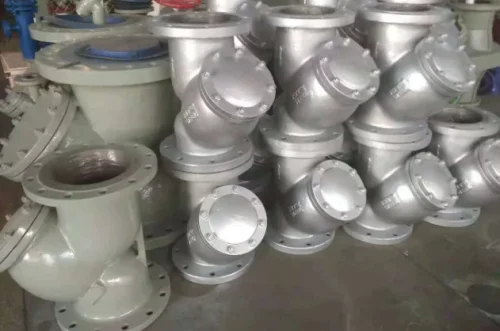
- Y Strainer: Compact angled screen design for water, steam, gas and general industrial service.
- Simplex Basket Strainer: Removable large area basket for higher flow and debris loading; line isolation is required for cleaning.
- Duplex Basket Strainer: Twin basket design allows flow changeover so one basket can be cleaned while the system remains operating.
Screen and Basket Construction:
The screen or basket is the main filtration component.
Common constructions include:
- Perforated stainless steel sheet
- Wire mesh supported by a perforated screen
- Multi-layer screen assemblies
- Reinforced baskets for high differential pressure
Screen material must provide adequate mechanical strength while remaining compatible with the process medium.
Mesh Size and Open Area Selection:
Screen opening should be selected according to the smallest particle size that could damage downstream equipment.
Selection should consider:
- Required particle retention
- Process fluid viscosity
- Solids concentration
- Downstream equipment tolerance
- Allowable clean pressure drop
- Maximum dirty pressure drop
- Screen strength
- Cleaning interval
The open area ratio describes the available flow area through the screen relative to pipeline cross sectional area.
Technical Specifications:
| Parameter | Typical Specification |
| Types | Y Strainer, Simplex Basket Strainer, Duplex Basket Strainer |
| Size Range | DN15–DN2000 depending on design |
| Pressure Rating | PN10–PN420 / ASME Class 150–2500 depending on construction |
| Body Materials | Cast Iron, Ductile Iron, Carbon Steel, Stainless Steel, Duplex, Super Duplex and special alloys |
| Screen Material | Stainless Steel perforated sheet or mesh-lined construction |
| Screen Opening | Selected according to particle-retention requirement |
| End Connections | Flanged, Butt Weld, Socket Weld, Threaded depending on type |
| Flange Standards | EN 1092 / ASME B16.5 or applicable project standard |
| Pressure Testing | EN 12266-1 / API 598 where applicable |
| Service | Water, Steam, Oil, Gas and compatible industrial process fluids |
| Cleaning | Manual removal continuous changeover available with duplex design |
Pressure Drop and Flow Capacity:
A strainer creates resistance as the process fluid passes through the screen.
Pressure drop depends on:
- Pipeline flow rate
- Strainer size
- Fluid density and viscosity
- Screen perforation
- Mesh size
- Available open area
- Quantity of retained debris
Pressure loss is lowest with a clean screen and increases as contaminants accumulate.
For critical services, differential pressure connections can be used upstream and downstream of the strainer. A rising differential pressure provides an indication that the basket or screen requires cleaning.
Cleaning and Maintenance Access:
Maintenance requirements should be considered when selecting the strainer type and installation location.
- Y Strainer: Screen removed through the branch cover after isolation and depressurization.
- Simplex Basket Strainer: Top cover allows basket removal; sufficient vertical clearance is required.
- Duplex Basket Strainer: Flow can be switched to the clean chamber for maintenance without full shutdown.
- Drain/Vent Connections: Support safe depressurization and cleaning.
- Inspection Points: Check for blockage, corrosion, mesh damage, deformation and perforation failure.
Pump and Equipment Protection Applications:
Strainers are installed upstream of equipment that could be damaged or obstructed by pipeline debris.
Typical applications include:
- Pump suction and discharge systems
- Control valve inlet lines
- Heat exchangers
- Flow meters
- Steam systems
- Cooling-water networks
- Industrial water systems
- Chemical process lines
- Oil and fuel systems
- Power generation utilities
- Marine piping
- Process equipment protection
Y strainers are useful where compact installation is required, simplex basket strainers provide greater dirt holding capacity for liquid service, and duplex strainers are selected where filtration must continue during basket cleaning.
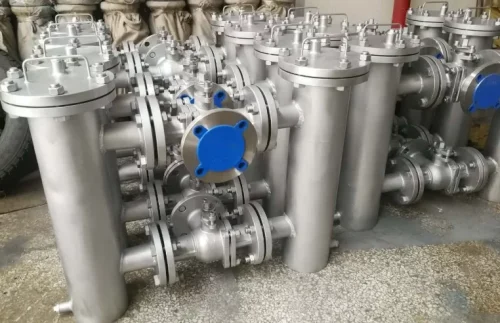
Duplex Basket Strainer
Price range: €330.00 through €10,784.00
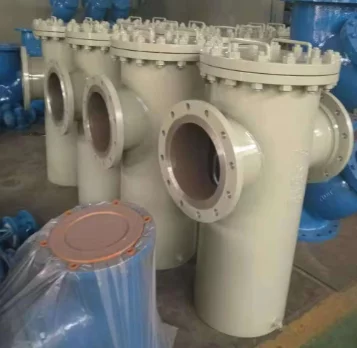
Simplex Basket Strainer
Price range: €194.13 through €3,471.71
Y Strainer
Price range: €20.30 through €2,449.69