
Knife Gate Valve Manufacturer in Germany
Knife gate valves provide on/off isolation in pipelines carrying slurry, suspended solids, fibres, sludge and other media that can obstruct conventional valve designs. A thin gate moves perpendicular to the flow path and passes through the process medium before reaching the seat, allowing the valve to isolate solids-containing pipelines with a relatively compact body.
Slurry Isolation Through Blade Type Closure
- The closure element of a knife gate valve is a thin metal gate that moves vertically through the valve body.
- When open, the gate retracts from the flow path to provide a substantially unrestricted passage.
- During closing, the gate passes through the flowing or settled media and enters the seating area.
- The relatively thin gate can displace or shear through soft solids, fibres and slurry deposits more effectively than many conventional wedge gate designs.
- Knife gate valves are primarily designed for isolation service. Continuous throttling should only be considered where the specific valve, seat and gate construction has been engineered for that duty.
Unidirectional and Bidirectional Designs:
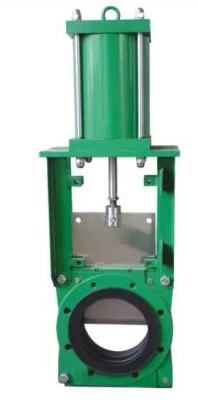
Unidirectional Knife Gate Valve
- Seals effectively against pressure from one main direction.
- Best suited for pipelines with fixed flow direction.
- Correct installation direction is important for proper shut-off.
Bidirectional Knife Gate Valve
- Provides sealing against pressure from either side.
- Suitable where flow reversal or pressure from both directions can occur.
- Useful for changing pump arrangements and two-way isolation.
- Pressure limits should be confirmed for the selected design.
Through Conduit and Slurry Configurations
Through Conduit Knife Gate Valve
A through conduit design provides a clear flow passage through the valve when fully open.
Reduced internal cavities help limit locations where solids can settle and accumulate.
These valves can be used for:
- Slurry pipelines
- Bulk solids
- Fibrous media
- High solids process streams
Slurry Knife Gate Valve
Slurry configurations are designed for abrasive and solids-laden media.
Features may include:
- Replaceable resilient sleeves or seats
- Hardened gate surfaces
- Flush ports
- Heavy-duty body construction
- Full bore passage
- Abrasion resistant materials
The valve should be selected according to particle size, solids concentration and fluid velocity rather than simply describing all slurry service as identical. Hard mineral particles can cause significant seat and gate wear even where a knife gate design is used.
Technical Specifications
| Parameter | Typical Specification |
| Types | Unidirectional, Bidirectional, Slurry, Through Conduit, Flanged |
| Size Range | DN50–DN1200 |
| Pressure Rating | PN10–PN25 in the standard range; higher-pressure designs require specific qualification |
| Body Materials | Cast Iron, Ductile Iron, Carbon Steel, SS304/316, Duplex, Hastelloy, Alloy 20 |
| Gate Materials | SS304, SS316, Duplex, Super Duplex, Hastelloy or service-specific alloy |
| Seat Materials | EPDM, NBR, FKM, PTFE, Metal, slurry sleeves |
| End Connections | Wafer, Lug, Flanged |
| Typical Temperature | Approximately -20°C to +200°C depending on body, seat and packing |
| Operation | Handwheel, Gearbox, Pneumatic, Electric, Hydraulic |
| Design Standard | MSS SP-81 for applicable stainless/stainless-lined bonnetless flanged designs; MSS SP-135 for applicable high-pressure designs |
| Testing | MSS SP-151 / EN 12266-1 or agreed project requirements |
| Face-to-Face | EN 558 or applicable design standard |
Solids Handling and Discharge Behaviour
Solids-containing pipelines require consideration of how material behaves around the gate and seat during operation.
Important factors include:
- Particle size
- Solids concentration
- Slurry density
- Abrasiveness
- Fibre length
- Settling tendency
- Flow velocity
- Operating frequency
A full opening helps reduce obstruction when the valve is open, while the thin gate helps pass through accumulated material during closing.
However, hard particles trapped in the seat can prevent full closure or damage resilient sealing elements.
Flush connections can therefore be useful on selected designs to remove material from body cavities or seat areas.
For abrasive service, replaceable seats and accessible gate components can reduce maintenance time.
Actuation and Installation Orientation
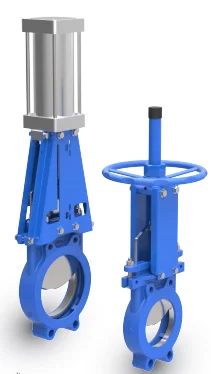
Knife gate valves can be manually or automatically operated.
- Manual: Handwheel or gear operation for low frequency local control.
- Pneumatic: Fast linear actuation for automated slurry and wastewater service.
- Electric: Remote operation where electrical control is preferred.
- Hydraulic: High thrust actuation for large or demanding valves.
- Installation: Prefer vertical stem orientation where practical, support heavy actuators separately and allow full gate/actuator clearance.
Mining, Pulp and Wastewater Applications
Knife gate valves are used where conventional isolation valves may trap or become obstructed by solids.
Typical applications include:
- Mining slurry pipelines
- Mineral processing
- Tailings systems
- Pulp and paper stock
- Wastewater sludge
- Sewage treatment
- Power plant ash handling
- Flue gas treatment systems
- Dredging
- Cement processing
- Bulk material handling
- Chemical slurry
- Industrial effluent
Unidirectional valves suit fixed-flow installations, bidirectional designs support pressure from either side, and slurry configurations provide specialised seating and wear features for abrasive media.
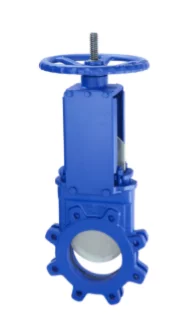
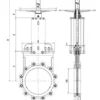
Bi Directional Knife Gate Valve
Price range: €213.12 through €6,015.12
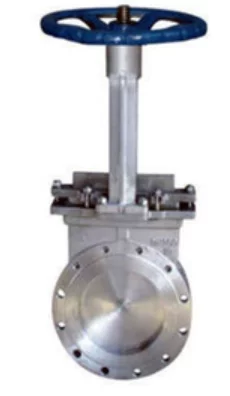
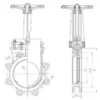
Flanged Knife Gate Valve
Price range: €226.00 through €6,090.00
Slurry Knife Gate Valve
Price range: €690.00 through €965.00
Through Conduit Knife Gate Valve
Price range: €230.21 through €3,199.34
Unidirectional Knife Gate Valve
Price range: €193.12 through €5,735.12