
Ball valves provide quick shut-off in industrial pipelines using a spherical ball that rotates 90 degrees to open or close the flow passage. Their straight-through bore, compact construction and tight sealing make them suitable for handling liquids, gases and other process media under different pressure and temperature conditions.
Valves Only Europe is a Ball Valve Manufacturer in Germany, providing floating, trunnion-mounted, fully welded and specialised ball valves for crude oil transmission, natural gas distribution, refinery equipment isolation, chemical transfer lines and offshore process systems. The range includes manual and actuated configurations with different body constructions, seat designs and end connections.
Key Features of Ball Valves
- Quarter-Turn Operation: Opens or closes the valve through a 90-degree rotation.
- Tight Shut-Off: Soft-seated designs provide low-leakage isolation under specified operating conditions.
- Full-Bore Flow: Provides a less restricted flow path and supports pipeline pigging in suitable designs.
- Anti-Static Construction: Maintains electrical continuity between the ball, stem and body in equipped configurations.
- Pressure-Energized Seats: Used in trunnion-mounted valves to support sealing under differential pressure.
- Corrosion Resistance: Stainless steel, duplex, super duplex and nickel alloys provide options for corrosive process media.
- Automated Operation: Pneumatic and electric actuators allow remote operation and integration with control systems.
Types of Ball Valves
|
|
|
Ball Valve Technical Specifications
| Parameter | Specification |
| Size Range | DN8–DN1600 |
| Pressure Rating | ASME Class 150–2500 |
| Casting Materials | Carbon Steel: ASTM A216 WCB, WCC; LTCS: ASTM A352 LCB, LCC; Alloy Steel: ASTM A217 WC6, WC9, C5; Stainless Steel: ASTM A351 CF8, CF8M, CF3, CF3M, Duplex & Super Duplex, Inconel & Hastelloy |
| Forged Materials | Carbon Steel: ASTM A105; LTCS: ASTM A350 LF2, LF3; Alloy Steel: ASTM A182 F11, F22, F5; Stainless Steel: ASTM A182 F304, F304L, F316, F316L |
| Standards | API 6D, API 608, ISO 17292, ASME B16.34, API 598, API 6D, EN 12266-1, API 607, ISO 10497 |
| Body Construction | One-Piece, Two-Piece, Three-Piece, Top Entry, Side Entry, Fully Welded |
| Ball Design | Floating, Trunnion-Mounted |
| Seat Material | PTFE, RPTFE, PEEK, Nylon, Devlon, Metal |
| Bore Design | Full Bore, Reduced Bore |
| End Connections | Flanged RF/RTJ, Threaded, Socket Weld, Butt Weld, Hub |
| Operation | Lever, Gearbox, Pneumatic Actuator, Electric Actuator |
How Does A Ball Valve Work?
A ball valve operates through a spherical closure element connected to a stem. When the bore aligns with the pipeline, fluid passes through the valve. A quarter-turn rotates the solid section of the ball across the flow passage and closes the valve.
The way the ball is supported affects sealing and operating torque.
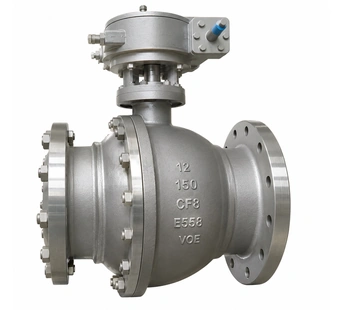
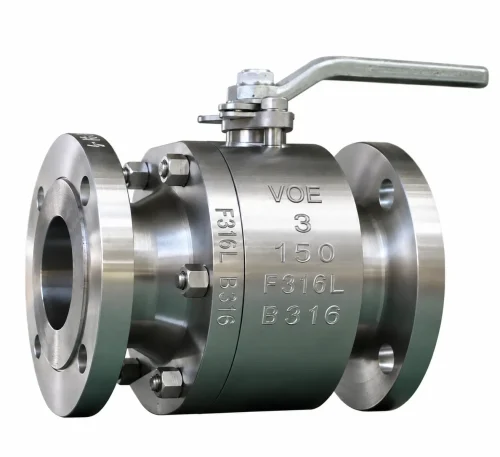
In a floating ball valve, the ball moves slightly towards the downstream seat under line pressure. In a trunnion-mounted ball valve, the ball is mechanically supported while the seats maintain sealing contact against its surface. Trunnion-mounted designs are commonly selected for larger sizes and higher-pressure services.
Industries Served
- Oil and Gas
- Chemical Processing
- Petrochemical
- Power Generation
- Marine and Offshore
- Mining and Mineral Processing
- Water Treatment
- Industrial Manufacturing
- Hydrogen Infrastructure




Fully Welded Ball Valve
Price range: €778.00 through €278,284.00


Jacketed Ball Valve
Price range: €19.50 through €504.20


Three Way Ball Valve
Price range: €899.00 through €9,899.00


Trunnion Ball Valve
Price range: €186.00 through €67,927.00