

Check Valve Manufacturer in Germany
Valvesonly Europe manufactures check valves also known as non return valves (NRVs) or one way valves designed to permit fluid flow in a single direction while automatically preventing backflow. Operating without external actuation, these valves respond directly to the differential pressure and velocity of the process medium, closing the moment flow reverses or stalls.
What is a Check Valve?
A Check Valve is a self actuating valve that allows fluid to flow in one direction and automatically prevents reverse flow. It opens under forward pressure and closes when flow stops or reverses, protecting pipelines, pumps, and equipment from backflow.
Working Principle and Flow Dynamics:
The performance of a check valve is governed by three interrelated variables:
- Cracking pressure – the minimum upstream pressure differential required to lift the disc or ball off its seat and initiate flow.
- Reseating pressure – the differential at which the obturator returns to its seat and achieves a bubble tight or metal to metal seal.
- Response time / closing velocity – how quickly the valve closes relative to the deceleration rate of the fluid column, which directly influences water hammer and pressure surge behavior in the pipeline.
Types of Check Valve We Manufacture:
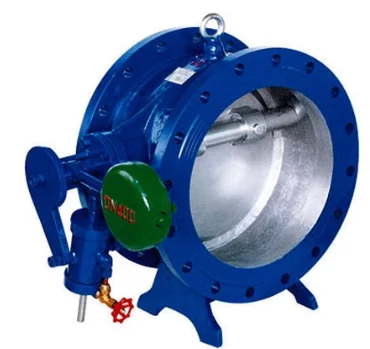
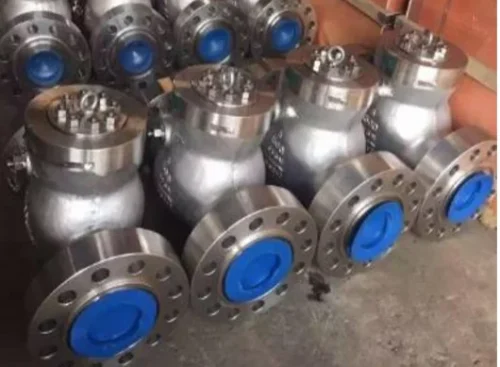
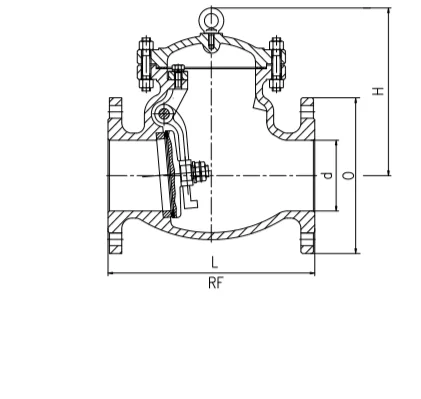
- Swing Check Valve – Hinged disc design that prevents reverse flow in horizontal and vertical pipelines.
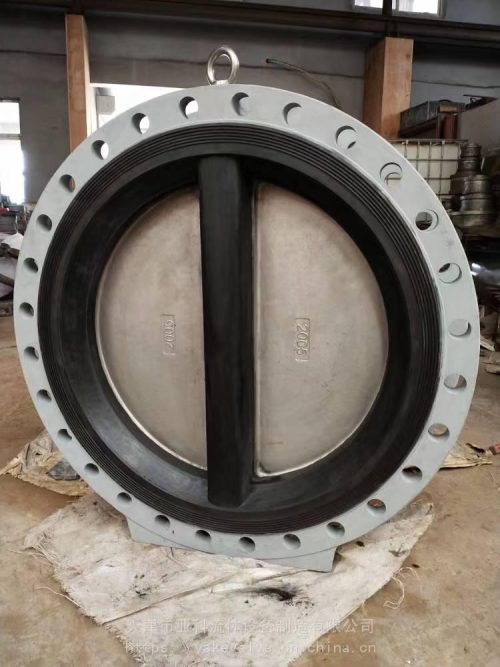
- Dual Plate Check Valve – Two spring loaded plates provide fast closure in a compact wafer design.
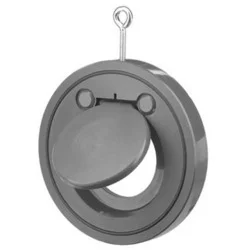
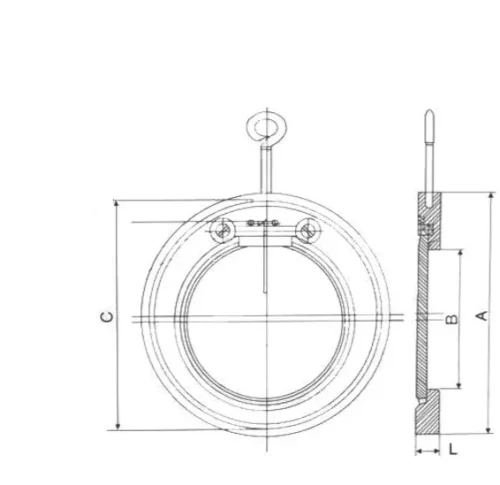
- Single Plate Wafer Check Valve – Lightweight wafer valve with a spring loaded disc for efficient backflow prevention.
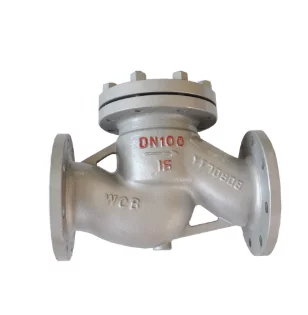
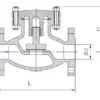
- Lift Check Valve – Vertical lifting disc suitable for high pressure and high velocity applications.
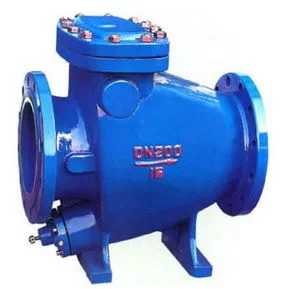
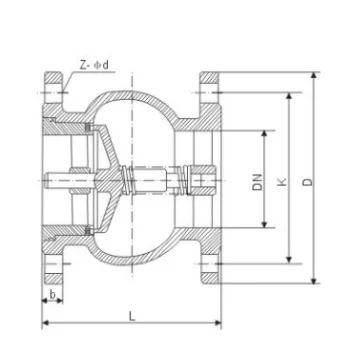
- Non-Slam Swing Check Valve – Spring assisted disc minimizes water hammer and flow surge.
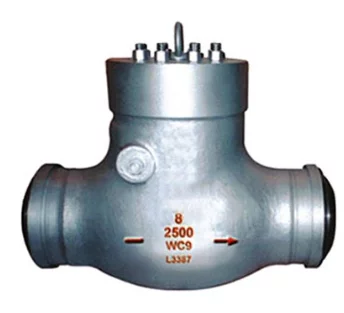
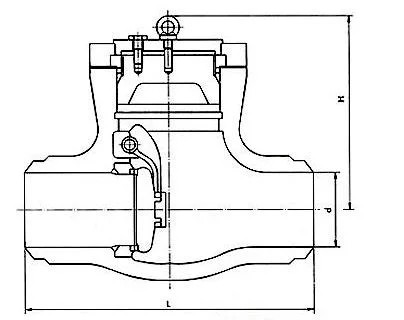
- Pressure Seal Swing Check Valve – Pressure sealed bonnet design for high pressure and high temperature service.
- Tilting Disc Check Valve – Low pressure loss design with quick response to changing flow conditions.
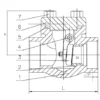
- Forged Steel Swing Check Valve – Forged construction for demanding high pressure and small bore piping systems.
Technical Specifications:
| Parameter | Range / Options |
| Nominal size (DN/NPS) | DN15 – DN1200 (½” – 48″) |
| Pressure class | PN10 – PN450; ANSI Class 150 – 2500 |
| End connections | Flanged (RF/RTJ), Butt weld, Threaded (BSP/NPT), Wafer, Lug |
| Body materials | Cast steel (WCB/WCC), Stainless steel (CF8/CF8M), Ductile iron, Forged steel (A105), Bronze, Alloy 20, Duplex/Super Duplex |
| Trim materials | Stainless steel, Stellite-faced, Monel, Hastelloy |
| Design temperature | -196°C to +550°C (cryogenic to high-temperature service) |
| Design/manufacturing standards | API 594, API 6D, BS 1868, BS EN 12334, ASME B16.34, ASME B16.10 |
| Testing standards | API 598, ISO 5208, EN 12266 |
| Face to face dimensions | API 594 / ASME B16.10 compliant |
Materials of Construction and Sealing Options:
Body and trim material selection is determined by the process medium’s corrosivity, temperature, pressure, and abrasiveness:
- Cast/Ductile Iron – general water, wastewater, and low pressure utility lines
- Cast Carbon Steel (WCB) – hydrocarbon and general industrial process lines
- Stainless Steel (CF8/CF8M, 316/316L) – corrosive chemical streams and marine environments
- Duplex and Super Duplex Alloys – high chloride, high pressure offshore and subsea applications
- Bronze – low pressure marine and cooling water systems
Seat and seal configurations include resilient elastomeric seats (NBR, EPDM, Viton/FKM, PTFE) for bubble tight shutoff at lower pressures and temperatures, and metal to metal seats (often Stellite overlaid) for high temperature and abrasive service applications.
Standards, Codes, and Certification:
Every check valve leaving our facility is designed and pressure tested in accordance with recognized international codes, including API 594 and API 6D for design, API 598 and ISO 5208 for shell and seat testing, and ASME B16.34 for pressure-temperature ratings. Fire safe designs per API 607/API 6FA are available on request for offshore, marine, and process critical pipeline projects.
Check valve Applications:
- Oil & Gas – pipeline transmission, pump/compressor discharge, subsea flowlines
- Water & Wastewater – pump station discharge, sewage lift stations, desalination plants
- Power Generation – boiler feedwater, cooling water circuits, condensate return lines
- Marine & Offshore – ballast systems, bilge lines, seawater cooling circuits
- Chemical Processing – corrosive and hazardous fluid transfer lines
- Mining & Slurry Transport – abrasive, particulate heavy media handling
- Irrigation & Agriculture – pump discharge and distribution networks
Advantages of Valvesonly Europe Check Valve:
- Self actuated closure eliminates the need for external control power or operator intervention
- Configurable cracking and reseating pressures matched to system flow characteristics
- Reduced water hammer through dual plate and piston damped designs
- Compact wafer style footprints for space constrained pipe runs
- Broad material compatibility for corrosive, abrasive, and high temperature media
- Fire safe and low emission (fugitive emission tested) configurations available
Installation and Maintenance Guidance:
Correct orientation and location extend service life and preserve sealing performance:
- Flow direction – install per the arrow cast or stamped on the body reversed installation prevents opening entirely.
- Orientation – swing and tilting disc types typically require horizontal installation or vertical with upward flow, depending on design lift and piston types accommodate both, subject to manufacturer confirmation.
- Upstream disturbance – allow adequate straight pipe length downstream of elbows, pumps, or control valves to avoid turbulence induced disc chatter.
- Inspection intervals – periodic borescope or disassembly inspection of seat, disc, and hinge components is advised in erosive or high cycle services.
- Spare parts – seat inserts, hinge pins, springs, and disc assemblies are available as interchangeable spare kits for field servicing.
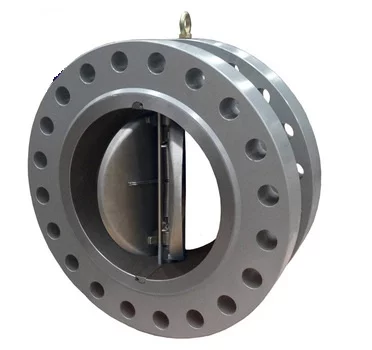
Dual Plate Lug Check Valve
Price range: €831.50 through €9,365.00
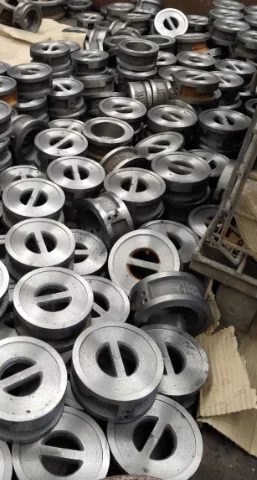
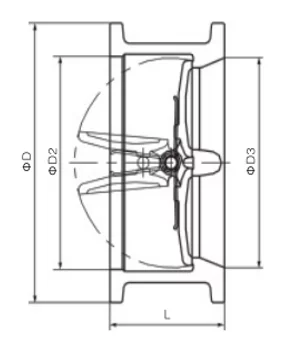
Dual Plate Wafer Check Valve
Price range: €12.21 through €14,544.35
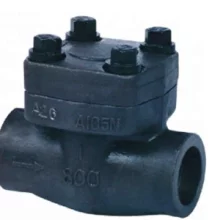
Forged Steel Swing Check Valve
Price range: €20.36 through €465.46
Lift Check Valve
Price range: €128.00 through €6,890.00
Non Slam Swing Check Valve
Price range: €232.00 through €477.00
Single Plate Wafer Check Valve
Price range: €83.20 through €1,316.80
Swing Check Valve
Price range: €15.00 through €9,752.97