
Needle Valve Manufacturer in Germany
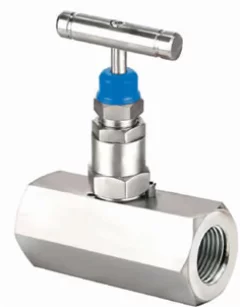
Needle valves provide fine flow regulation in small-bore instrumentation, sampling and high-pressure piping systems. A long tapered stem tip moves gradually into a matching seat or orifice, allowing small changes in flow area over multiple handwheel turns.
Fine Flow Regulation in Small Bore Lines
This provides controlled adjustment for:
- Instrument lines
- Sample systems
- Pressure gauges
- Hydraulic circuits
- Gas systems
- Bleed and vent points
- Calibration systems
Needle valves are most suitable for relatively low flow rates and small-bore piping.
They should not normally be selected as the primary flow-control device for large process lines because the small internal flow passage produces comparatively high pressure loss.
Tapered Stem and Seat Operation
Rotating the handwheel moves the threaded stem axially.
As the tapered tip approaches the seat, the annular opening decreases gradually. Because a significant number of turns may be required between fully open and fully closed positions, the operator can make small adjustments to flow.
Stem tip designs can include:
- Regulating/Vee tip
- Fine needle tip
- Non rotating tip
- Blunt or shut off tip
A non-rotating stem tip can reduce rubbing between the needle and seat during closing.
The exact flow characteristic depends on stem geometry, seat design and valve opening; it should not automatically be described as perfectly linear.
Straight, Angle and Multiport Designs
- Straight Needle Valve: Inline design for flow adjustment and instrument isolation.
- Angle Needle Valve: 90° flow path for regulation where piping direction changes.
- Multiport Needle Valve: Combines functions such as gauge isolation, bleeding, venting, calibration and sampling.
- Manifold Use: Can be integrated into instrument manifolds for more complex pressure-control arrangements.
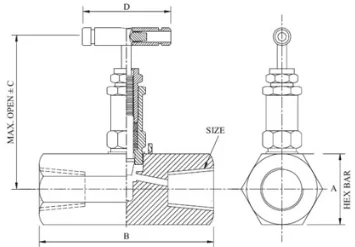
Stem Tip and Bonnet Construction
Typical components include:
- Forged or bar-stock body
- Fine-thread stem
- Tapered regulating tip
- Integral or renewable seat
- Bonnet
- Packing
- Handwheel or T-handle
Bonnet arrangements can include:
- Integral bonnet
- Union bonnet
- Threaded bonnet
Back-seating features may be provided on suitable designs but should not be treated as universal across every needle valve.
The body can be machined from bar stock or forged material where compact, high-pressure construction is required.
Technical Specifications
| Parameter | Typical Specification |
| Size Range | DN6–DN50 / NPS 1/8–2 |
| Pressure Rating | Up to approximately 6000 psi / 413 bar in standard high-pressure configurations; higher ratings design-dependent |
| ASME Classes | Class 150–2500 for applicable class-rated designs |
| Body Materials | SS316/316L, SS304, Carbon Steel, Alloy Steel, Duplex, Super Duplex and special alloys |
| Stem | Stainless Steel or compatible hardened alloy |
| Seat | Integral Metal, Renewable Metal, PTFE or PEEK depending on design |
| Packing | PTFE, Graphite or service-specific packing |
| Connections | NPT, BSP, Compression Tube, Socket Weld, Butt Weld, Flanged |
| Operation | Handwheel / T-Handle |
| Instrument Valve Standard | MSS SP-99 where applicable |
| Pressure Design | ASME B16.34 for applicable class-rated valve construction |
| Testing | API 598 / EN 12266-1 or applicable instrument-valve test procedure |
Pressure and Temperature Selection
Needle valve selection requires both the maximum pressure and operating temperature.
Important considerations include:
- Maximum working pressure
- Differential pressure
- Temperature
- Media
- Required flow adjustment
- Seat material
- Connection type
- Cycling frequency
A valve that is rated for high pressure at ambient temperature may have a lower allowable pressure at elevated temperature.
Likewise, metallic body materials may tolerate temperatures well above the practical limits of PTFE or other soft seating materials.
Cryogenic or very-high-temperature applications require specialised packing, material and bonnet configurations rather than simply applying the broad raw-material temperature capability to every valve.
Instrumentation and Sampling Applications
Needle valves are commonly used for:
- Pressure gauge isolation
- Instrument manifolds
- Sampling systems
- Analyzer lines
- Hydraulic circuits
- Pneumatic control systems
- Laboratory systems
- Chemical dosing
- Bleed and vent connections
- Oil and gas instrumentation
- Steam sampling
- Calibration equipment
Their primary advantage is the ability to make small, repeatable adjustments in low-flow systems while also providing shut off when the stem is fully seated.