
Triple Duty Valve Manufacturer in Europe
A triple duty valve combines three functions required on a pump discharge line non-return protection, flow balancing and positive isolation within a single valve body. By replacing separate check, balancing and shut-off valves, the design reduces the number of fittings required around the pump while providing one accessible point for system adjustment and maintenance.
Three Pump Discharge Functions in One Valve
A conventional pump discharge arrangement may require a check valve to prevent reverse flow, a balancing valve to regulate system flow and an isolation valve for pump maintenance.
A triple duty valve incorporates these functions into one assembly:
- Non-slam check function for reverse-flow prevention
- Throttling and balancing function for flow adjustment
- Shut-off function for pump isolation
Combining these functions reduces installation length and the number of flanged or threaded joints in the pump discharge piping.
The valve is mainly intended for pump-system service rather than general-purpose pipeline isolation.
Non Slam Check Function
When the pump operates, forward differential pressure moves the disc away from its seat and allows flow through the valve.
If the pump stops or flow begins to reverse, the spring-assisted disc moves toward the seat. The shorter closing movement helps reduce the reverse velocity that develops before shut-off.
This check function helps protect:
- Pumps
- Motors
- Connected equipment
- Distribution piping
from reverse rotation, backflow and pressure disturbances.
The degree of surge protection depends on the complete hydraulic system, including flow velocity, pump trip behaviour and pipeline characteristics.
Flow Balancing and Throttling Function
The disc can be positioned between fully open and fully closed to introduce a controlled resistance into the system.
This allows the installer or commissioning engineer to adjust the flow rate through a pump circuit to match the design requirement.
Balancing is commonly performed by measuring the pressure differential across integrated test points and comparing it with valve performance data.
Important parameters include:
- Required flow rate
- Differential pressure
- Valve position
- Kv/Cv value
- Pump operating point
The valve should not be excessively throttled without considering the resulting velocity and pressure loss.
Positive Shut Off Function
For maintenance, the disc can be moved to the fully closed position to isolate the pump from the downstream piping.
Many triple duty valve designs incorporate a memory stop or position-setting mechanism. After the valve has been commissioned at the required balancing position, the setting can be recorded mechanically.
The valve can then be:
- Closed for pump maintenance.
- Reopened after service.
- Returned to its previous balancing position.
This reduces the need to rebalance the system after routine pump maintenance.
Technical Specifications
| Parameter | Typical Specification |
| Size Range | DN50–DN600 |
| Pressure Rating | PN16–PN25 / Class 125–250 depending on construction |
| Functions | Check, Balancing/Throttling, Isolation |
| Body Materials | Cast Iron, Ductile Iron, Cast Steel, Stainless Steel |
| Disc / Plug Materials | Bronze, Coated Ductile Iron, Stainless Steel |
| Seat Materials | EPDM, NBR, PTFE depending on service |
| End Connections | Flanged; other configurations design-dependent |
| Operating Temperature | Approximately -10°C to +120°C depending on seat and body material |
| Operation | Handwheel / Gear mechanism |
| Position Control | Position Indicator and Memory Stop |
| Measurement | Integrated pressure / differential-pressure test ports where provided |
| Flange Standards | EN 1092-2 / applicable ASME flange requirements according to body material |
| Testing | EN 12266-1 or applicable project/manufacturer requirements |
Pressure Measurement and Adjustment
Pressure test ports installed on the valve body allow differential pressure to be measured during commissioning.
The measured differential pressure can be used with the manufacturer’s valve characteristic or Kv/Cv data to determine the approximate flow rate.
A typical commissioning procedure includes:
- Operating the pump at design condition
- Measuring pressure differential
- Adjusting valve opening
- Confirming required system flow
- Recording the final position
- Setting the memory stop
This allows the triple duty valve to function as both a commissioning device and an isolation component.
Balancing should be carried out with the overall pump curve and system resistance in mind so that unnecessary pressure loss is not introduced into the circuit.
Pump Discharge Installation
Triple duty valves are installed directly or close to the discharge side of centrifugal pumps in:
- Chilled water systems
- Hot water circulation
- Cooling water networks
- Cooling tower systems
- Booster pump stations
- District heating and cooling
- Industrial process water circuits
- Building and campus utility systems
The valve may be installed horizontally or vertically where the selected design permits.
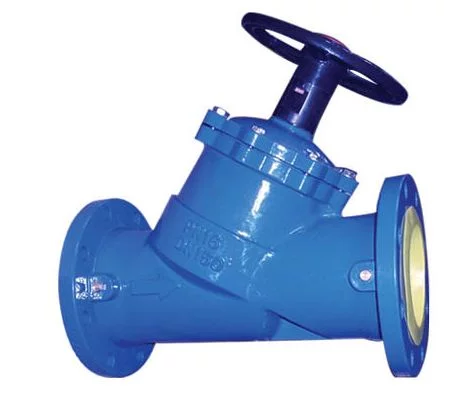
Triple Duty Valve
Price range: €60.00 through €1,995.00